February 4, 1897
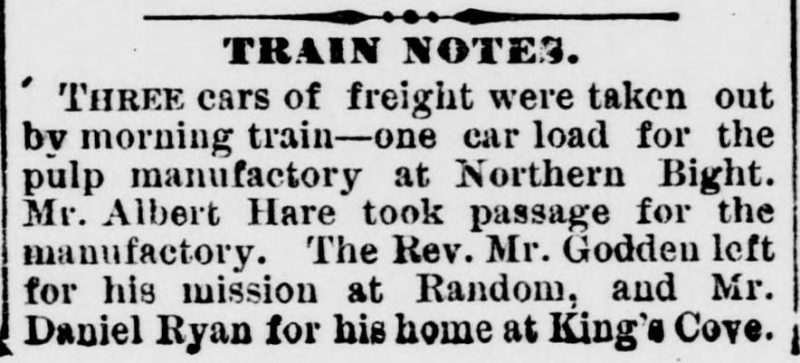 Train Notes
Three cars of freight were taken out by morning train – one car load for the pulp manufactory at Northern Bight. Mr. Albert Hare took passage for the manufactory. The Rev. Mr. Godden left for his mission at Random, and Mr. Daniel Ryan for his home at King’s Cove.
_____________________
May 4th, 1897
 The schooner Nonpariel ran bow on into the dry dock premises last evening, and her jibboon went through the store.
_____________________
May 5, 1897
 Legislative Proceedings.
House of Assembly.
Thursday, April 22nd.
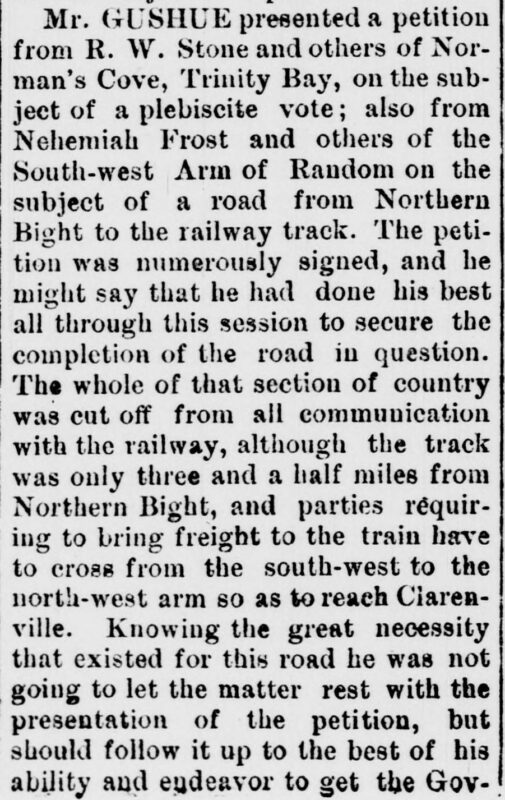
Mr. GUSHUE presented a petition from R. W. Stone and others of Norman’s Cove, Trinity Bay, on the subject of a plebiscite vote; also from Nehemiah Frost and others of the South-west Arm of Random on the subject of a road from Northern Bight to the railway track. The petition was numerously signed, and he might say that he had done his best all through this session to secure the completion of the road in question. The whole of that section of country was cut off from all communication with the railway, although the track was only three and a half miles from Northern Bight, and parties requiring to bring freight to the train have to cross from the south-west to the north-west arm so as to reach Ciarenville. Knowing the great necessity that existed for this road he was not going to let the matter rest with the presentation of the petition, but should follow it up to the best of his ability and endeavor to get the Government to grant the prayer of petitioners. If he failed in his object the fault would not be his own.
 Mr. JOHNSON had much pleasure in supporting the petition. The subject matter of it had been brought under his notice when he was in the district last fall, and he considered it a great hardship that the people of Northern Bight, Fox Harbor and other places in that section had to take their freight across in boats to reach the railway when three miles of a road would give them the communication they needed. If any place in Trinity district required a road it was the place in question.
Hon’ble. Mr. HORWOOD begged leave to endorse all that bad been said with regard to this road by his hon. colleagues, because, like them he knew the necessity that existed for it. He should use his best efforts to have the prayer of the petitioners acceeded to.
Mr. MORISON had very much pleasure in supporting the prayer of the petition. He knew that the road asked for was a most necessary one for he had heard complaints on the subject when he was in the district last fall. In fact he had heard such a bad account of the hardships to be encountered in reaching Northern Right from the railway that he refrained from going there at all. The people who would be immediately affected by the completion of this road were a hard working, industrious class and there was very little demand for poor relief among them. This being the case he thought they were entitled to a little assistance in such matters as the construction of a road. In fact, his idea was that new settlements in which there were no roads should get the preference, and that special attention should be given to them so as to encourage the enterprising settlers who were endeavoring to open up the country. Localities in which money had been expended on roads during the past 30 or 40 years did not require so much attention as those which were entirely without roads. He trusted that Mr. Gushue would follow this matter up so that before the year was out the people of that section would be in direct communication with the railway and could get on their produce to market. If the road in question was finished now, see what an advantage it would be for the people down there who had potatoes for sale and could then get them on to St. John’s where they would fetch from $1.60 to 32 per barrel. He thought that the benefits to be derived from the building of this road were so great that they would over-balance the immorality of spending the money required, just before an election, and he was quite willing that Mr. Gushue should get all the political advantage he could from the transaction provided the people got the road.
 Hon. PREMIER—The conduct of the hon. member who had just sat down, reminded him of a story he had once heard. It was of a poor man, who, being in great need of assistance made application to a number of individuals for relief. There were several present on the occasion who were very sympathetic in their expressions towards the poor man, but there the matter ended. There was, however, one old Quaker among them who remarked:—”Ye seem to be all very sorry for this poor man, and so am I. I am sorry $50, how much are ye sorry?” His learned friend, the leader of the Opposition, was very fond of expressing his sympathy with the people of the northern districts. He wanted them to have access to the railway, so that they could bring on their produce to market! Well, that was one of the advantages which the present Government and its supporters expected from the building of the railway when they undertook it. But the hon. gentleman’s lieutenant, only a few days, ago, spoke in strong condemnation of the railway policy, and said that it was ruinous to the country, while now the hon. gentleman himself was equally strong in setting forth the great benefits which the people of Northern Bight were going to derive from it. It was strange there should be such a difference of opinion between the leader of the Opposition and his lieutenant. He (Hon. Premier) however, agreed with the former as to the advantages of the railway, and the necessity of connecting the various settlements along the route with it, and the very road now under discussion was one of the railway connecting roads that were provided for in the session of 1893. In fact the road was partly built that year, and it was the intention to complete it the following year. But ’93 was election year, and when the elections were over, the Government of the day found themselves dragged before the Supreme Court and charged with bribery and corruption, because they had done the very thing which the hon. gentleman opposite now called upon them to do, namely, built railway connecting roads from the various settlements, so that the people of Northern Bight, Shoal Harbor, and other places, might “have an opportunity of bringing their produce on to market.” As he had said, the road referred to in the petition before the house, had been partly built in ’93, and would have been completed in ’94 had the present Government remained in office. Furthermore, he found that the hon. gentleman himself, when in power, appropriated a sum of money for that road, and promised that it should be completed; but the promise was never carried out, and the road remained as they had left it in ‘93. During the whole of the summer of ’94, although the money had been voted for the purpose, when a minute of Council had been made to that effect, and when the work should have been done, there was not a single stroke done on the road, though the money was spent otherwise. When the present Government again came into power, there was none of the railway-connecting-road-money left; it had all been expended by their predecessors, and none remained for this road, although it had been voted. He esteemed and respected the men of Trinity whom he represented in that house for a great many years, a more industrious and respectable class of men did not exist in this island, and he said that without disparaging any others. He had made provision for the construction of this very road by making it an appropriation of $100,000. In ’93 they had expended $44,000 upon it and the remainder should have been spent in ’94. He trusted that the road would soon be completed, and he would do all in his power to accomplish that result. But he could not help expressing his surprise at the remarkable attitude assumed now by the hon. member, Mr. Morison, respecting the road, who, when he had the power, ignored the claim for its completion, but now expatiates on the desirability of its being done by the Government.
 Mr. MOTT begged to support this petition, the presentation of the merits of which constituted one of the most business-like proceedings of the session, and the people of Trinity district, interested in this road, would have to thank the leader of the Opposition for the attention that had been drawn to the petition. If hon. members had been unseated by reason of work given on this road before the elections he might say that he had been over that road and that he had seen no evidences of money having been spent on it. He was certain that any hon. member who saw the bad condition of this road would support this petition.
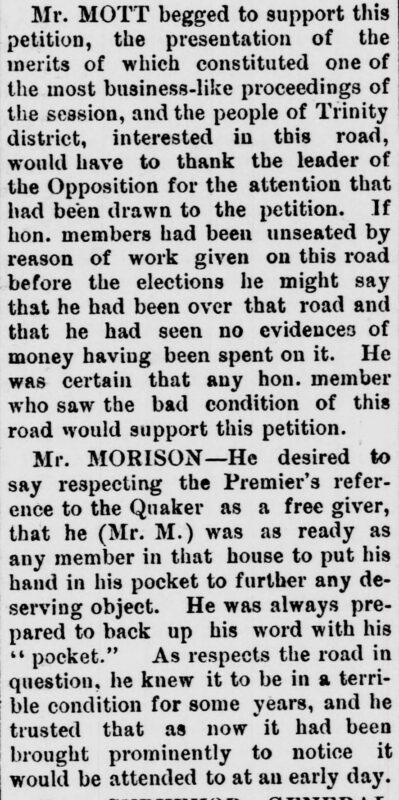 Mr. MORISON—He desired to say respecting the Premier’s reference to the Quaker as a free giver, that he (Mr. M.) was as ready as any member in that house to put his hand in his pocket to further any deserving object. He was always prepared to back up his word with his “pocket.” As respects the road in question, he knew it to be in a terrible condition for some years, and he trusted that as now it had been brought prominently to notice it would be attended to at an early day.
_____________________
May 27, 1897
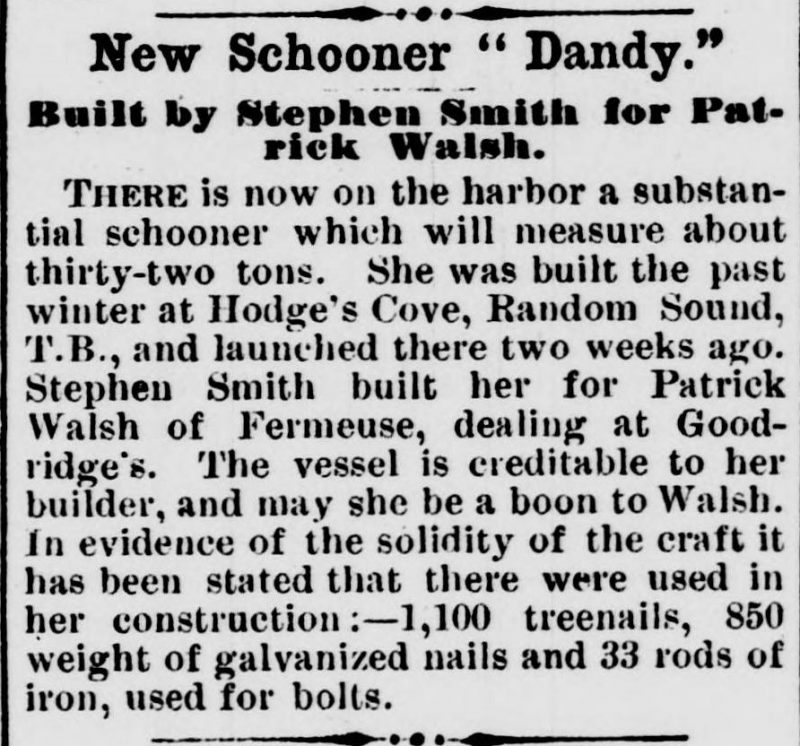 New Schooner Dandy.
Built by Stephen Smith for Patrick Walsh.
There is now on the harbor a substantial schooner which will measure about thirty-two tons. She was built the past winter at Hodge’s Cove, Random Sound, T. B., and launched there two weeks ago. Stephen Smith built her for Patrick Walsh of Fermuse, dealing at Goodridge’s. The vessel is creditable to her builder, and may she be a boon to Walsh. In evidence of the solidity of the craft it has been stated that there were used in her construction:—1,100 treenails, 850 weight of galvanized nails and 33 rods of iron, used for bolls.
_____________________
 June 2, 1897
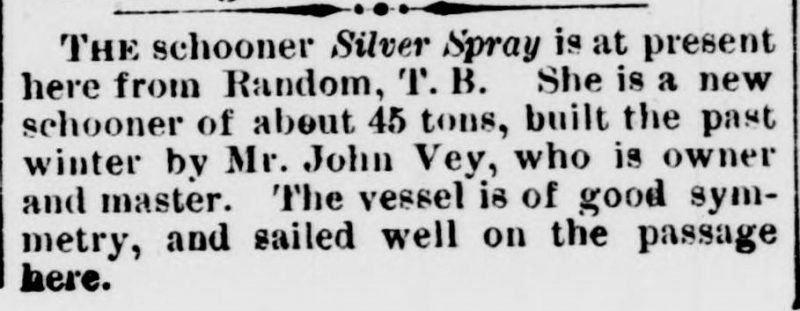
The schooner Silver Spray is at present here from Random, T.B. She is a new schooner of about 45 tons, built the past winter by Mr. John Vey, who is owner and master. The vessel is of good symmetry, and sailed well on the passage here.
_____________________
June 8, 1897
 MAGISTERIAL INQUIRIES.
A magisterial inquiry was held in the Police Court this forenoon, before Superintendent Sullivan, into the cause of the death of Stephen Drodge. which sad event occurred on the 7th of the present month, by drowning, from the schooner Jessie, of Heart’s Ease, Trinity Bay. Another inquiry was held in the case of Martin Cunningham, mate of the barque Cordelia, whose dead body was found this morning seated on a chest in his state-room. Full particulars of both appear in another column of today’s TELEGRAM.
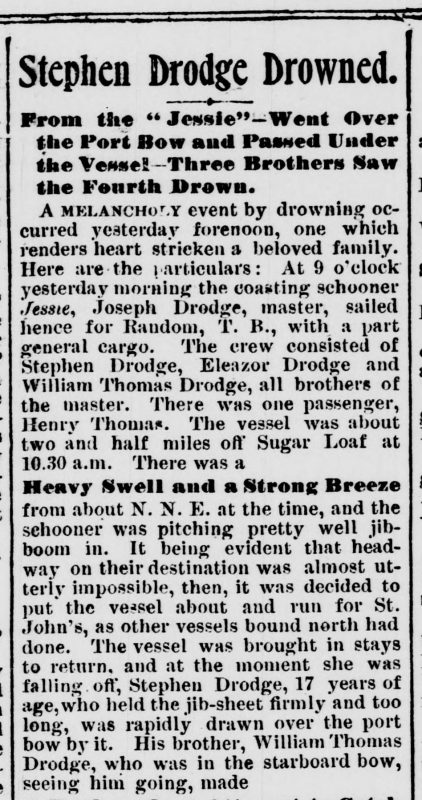 STEPHEN DRODGE DROWNED.
From the ” Jessie”- Went Over the Port Bow and Passed Under the Vessel – Three Brothers Saw the Fourth Drown.
A melancholy event by drowning occurred yesterday forenoon, one which renders heart stricken a beloved family. Here are the particulars: At 9 o’clock yesterday morning the coasting schooner Jessie, Joseph Drodge, master, sailed hence for Random, T. B., with a part general cargo. The crew consisted of Stephen Drodge, Eleazor Drodge and William Thomas Drodge, all brothers of the master. There was one passenger, Henry Thomas. The vessel was about two and half miles off Sugar Loaf at 10.30 a.m. There was a heavy swell and a strong breeze from about N. N. E. at the time, and the schooner was pitching pretty well jibboom in. It being evident that headway on their destination was almost utterly impossible, then, it was decided to put the vessel about and run for St. John’s, as other vessels bound north had done. The vessel was brought in stays to return, and at the moment she was falling off, Stephen Drodge, 17 years of age, who held the jib-sheet firmly and too long, was rapidly drawn over the port bow by it. His brother, William Thomas Drodge, who was in the starboard bow, seeing him going, made a dash and an 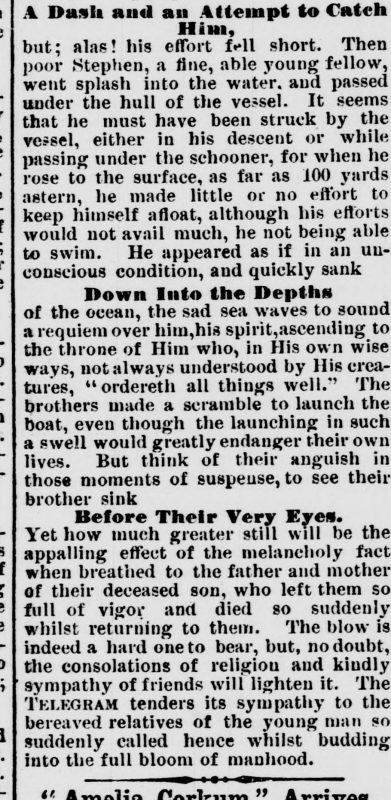 attempt to catch him, but; alas! his effort fell short. Then poor Stephen, a fine, able young fellow, went splash into the water, and passed under the hull of the vessel. It seems that he must have been struck by the vessel, either in his descent or while passing under the schooner, for when he rose to the surface, as far as 100 yards astern, he made little or no effort to keep himself afloat, although his efforts would not avail much, he not being able to swim. He appeared as if in an unconscious condition, and quickly sank down Into the depths of the ocean, the sad sea waves to sound a requiem over him, his spirit, ascending to the throne of Him who, in His own wise ways, not always understood by His creatures, “ordereth all things well.’ The brothers made a scramble to launch the boat, even though the launching in such a swell would greatly endanger their own lives. But think of their anguish in those moments of suspense, to see their brother sink before their very eyes. Yet how much greater still will be the appalling effect of the melancholy fact when breathed to the father and mother of their deceased son, who left them so full of vigor and died so suddenly whilst returning to them. The blow is indeed a hard one to bear, but, no doubt, the consolations of religion and kindly sympathy of friends will lighten it. The Telegram tenders its sympathy to the bereaved relatives of the young man so suddenly called hence whilst budding into the full bloom of manhood.
____________________
August 21, 1897
 New Advertisements
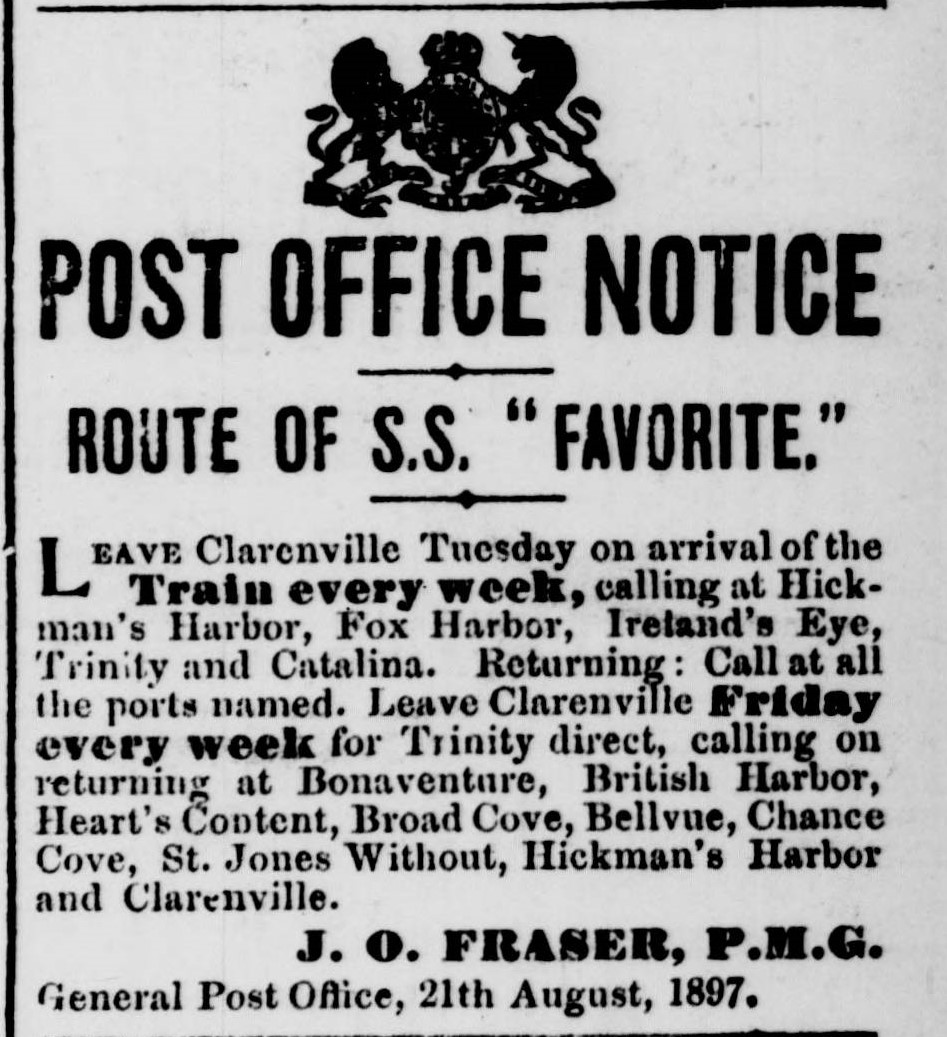
Post Office Notice
Route of S.S. “Favorite.”
Leave Clarenville Tuesday on arrival of the Train every week, calling at Hickman’s Harbor, Fox Harbor, Ireland’s Eye, Trinity and Catalina. Returning: Call at all the ports named. Leave Clarenville Friday every week for Trinity direct, calling on returning at Bonaventure, British Harbor, Heart’s Content, Broad Cove, Bellvue, Chance Cove, St. Jones Without, Hickman’s Harbor and Clarenville.
_____________________
 September 4, 1897
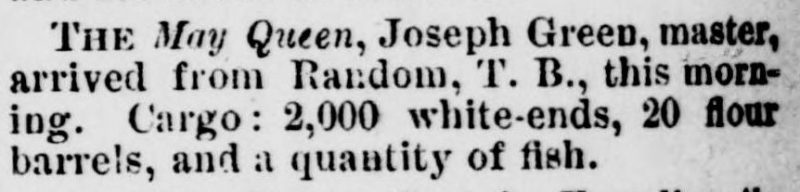
The May Queen, Joseph Green, master, arrived from Random, T.B., this morning. Cargo: 2,000 white-ends, 20 flour barrels, and a quantity of fish.
_____________________
December 3, 1897
We believe that shipbuilding will be carried on with renewed vigor in this [Trinity] bay the coming winter, by its industrious inhabitants. Four schooners are already in course of construction. Messrs. Drover, of Hodge’s Cove, have laid the keel of a fine craft for themselves; and Mr. A. Gardner, of British Harbor, is about to commence building one for Mr. Barbour, of Pool’s Island, which schooners will run in the Labrador trade.
_____________________
December 14, 1897, Page 4
 Marine Notes
The Avalanche, James Frost, master, has been cleared for Sound Island, P. B., taking 30 herring barrels, 2 puncheons molasses, etc.
 TRAIN NOTES.
Two cars of freight and 35 passengers by the 9.30 a.m. train. Among the passengers were: Messrs. R. McGrath, Nehemiah Frost, William Frost, W. Benson, and Constables Beckham, Kent and Spracklin.
_____________________
Transcribed by Wanda Garrett, Lester Green, and Emily Seward. Page created September 2014; Last update November 2022.
These transcriptions may contain human errors. As always, confirm these as you would any other source material.