May 4, 1895
 DESTRUCTIVE FIRE AT NORTHERN BIGHT
Mr. William Stoyles Loses Pretty Well All His Earthly Possessions — Letter from Rev. James Smith —
An Appeal for Help. Editor Evening Telegram. Dear Sir,—On the morning of Tuesday, 30th ult. [April 1895], between the hours of three and five, nearly all the earthly possessions of Mr. William Stoyles of this place, were destroyed by fire. Mr. Stoyles’s eldest son arose in the early morning and made on a fire in the kitchen stove, to prepare to go into the country; but, finding the weather unfavourable, again retired. Mrs. Stoyles remained up an hour later, but saw No Signs of Fire When She Retired. Nothing was known of any danger until Mr. Stoyles heard his son leap from his bed, but making no alarm. The father rushed upstairs and found the roof and ceiling wrapped in flame. He then screamed to his children to save themselves, which they did just as they came from their beds. One of the daughters, however, sustained considerable injury on the back from falling fire. The sleeping apartment of Mr. Stoyles being on 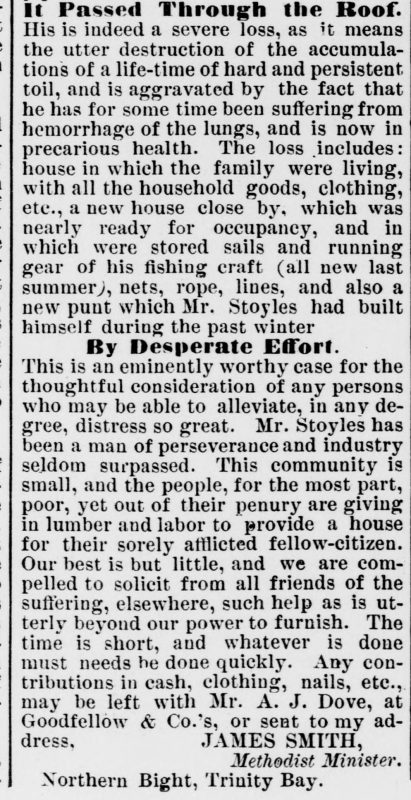 the ground floor, he managed to save his bed, but no bedding. How the fire originated is not known, but probably from the heat of the stove pipe where it passed through the roof. His is indeed a severe loss, as it means the utter destruction of the accumulations of a life-time of hard and persistent toil, and is aggravated by the fact that he has for some time been suffering from hemorrhage of the lungs, and is now in precarious health. The loss includes: house in which the family were living, with all the household goods, clothing, etc., a new house close by, which was nearly ready for occupancy, and in which were stored sails and running gear of his fishing craft (all new last summer – nets, rope, lines, and also a new punt which Mr. Stoyles had built himself during the past winter by desperate effort. This is an eminently worthy case for the thoughtful consideration of any persons who may be able to alleviate, in any degree, distress so great. Mr. Stoyles has been a man of perseverance and industry seldom surpassed. This community is small, and the people, for the most part, poor, yet out of their penury are giving in lumber and labor to provide a house for their sorely afflicted fellow-citizen. Our best is but little, and we are compelled to solicit from all friends of the suffering, elsewhere, such help as is utterly beyond our power to furnish. The time is short, and whatever is done must needs he done quickly. Any contributions in cash, clothing, nails, etc., may be left with Mr. A. J. Dove, at Goodfellow & Co.’s. or sent to my address.
JAMES SMITH, Methodist Minister. Northern Bight , Trinity Bay.
_____________________
May 27, 1895
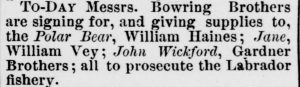
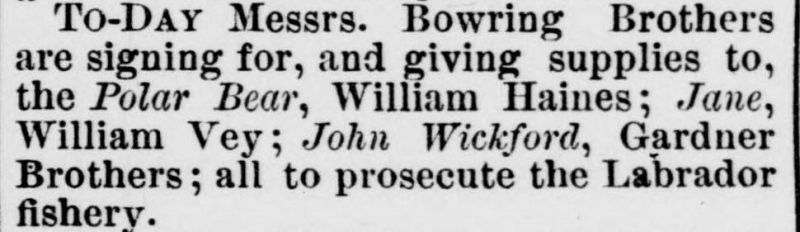
To-day Messrs. Bowring Brothers are signing for, and giving supplies to, the Polar Bear, William Haines; Jane, William Vey; John Wickford, Gardner Brothers; all to prosecute the Labrador fishery.
_____________________
October 12, 1895, Page 4
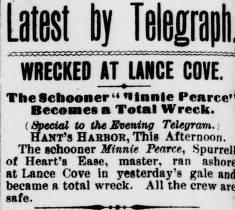 WRECKED AT LANCE COVE
 Our agent at Hant’s Harbor apprises us of the loss, at Lance Cove, Trinity Bay, in yesterday’s gale, of a schooner called the Minnie Pearce, of Heart’s Ease. We are not yet furnished with particulars of the disaster, beyond the fact that no loss of life resulted therefrom. Capt. Spurrell and his crew managed to reach the shore uninjured.
October 16, 1895
 UNDER BARE POLES.
A Schooner Sea-Tossed and Doomed to Destruction—Excitement Among the Spectators-Running for the Scene of the Wreck—The Rudder Broken—Caught in the Shifting Sands— Rescue of the Crew.
Never did the inhabitants of this place and those in close proximity to us ever witness such a distressing and pitiful sight as on yesterday morning when they looked off upon the phosphorescent deep and beheld a schooner scudding under bare poles and “sea-tossed” — soon to be ashore, where? No person knew just then. Much anxiety was felt alike by all for the lives of the men on board. Many stood looking sad and awe-stricken, for there seemed little hope of saving them from an ocean grave. After the elapse of a few minutes the might of the terrible wind and sea had brought her nearer to land, and it was obvious to all that at Lance Cove, two miles from here, and midway between Old Perlican and Hant’s Harbor, she would find a lodging place.
Soon all the men were seen running for the scene of the wreck, the gusts of wind almost lifting them from off their feet. Will she go to leeward of Western Point? was the question asked one of another. A few more dreaded moments passed and it was seen that she would. Then, signals were given to the men on board, a flag was hoisted on land for their guidance; but quickly she’s aground, the rudder is broken in pieces, a few more seas and she is lifted over the rocks and sticks in the shifting sand. In a little while ropes were ready, a boat that did service as a life-boat was launched, into which the men, numbering eight, were brought with some difficulty to land.
 The schooner was the Winnie Pierce, 42 tons, three years old, owned by Mr. Joseph Morris of Trinity. The names of the crew are Edward Spurrell, master, Moses Spurrell, Uriah Spurrell, David Spurrell, John Jacobs, William Balsam, Heman Bryant, and Charles Bryant, all inhabitant of Heart’s Ease and vicinity of Trinity Bay. They left St. John’s on Thursday morning at 2 o’clock, and reached Bay de Verde at 2 p.m. the same day, with double-reefed sails. Owing to the wind blowing strong from N.E., and it being dark, with rain, they anchored there. The master says that at 2 o’clock on Friday morning he was called on deck and, as a wise mariner should, took a searching look at the sky, ordered his crew on deck, and left again with the wind in their favor, blowing lightly from the south. All went well for some time, until when about 12 miles in the bay, they were met by this hurricane from the north, which completely carried away the staysail and mainsail and slit and tattered to pieces the foresail. The wind was still rising, and the white surf, churning and boiling over her, both combined to send forth that uncannv and gruesome sound that betokens a tempest and foretells sorrow on the sea. He then took the wheel and gave the mandate for each man to look out for himself. He confessed that there was but little hope, and told them so. The schooner became unmanageable at times; once she pitched over so far as to be on her “beam-end,” and there was fear that she would not be righted.
 The wonder to many is how she escaped the rocks and shoals of Salvage Point (of which there are many), the terror of navigators. Often the wrathful-looking billows threatened to swallow her up in their gaping jaws, and the crew expected the worst every moment. But one brave man, in the person of Mr. Chas. Bryant, like Paul, did his best to stimulate them with courage and bade them to “be of good cheer,” saying he was prepared for whatever awaited them. No doubt, he often repeated the sailor’s beautiful litany: “O Christ, whose voice the waters heard, and hushed their raging at Thy word; who walkedst on the foaming deep, and calm amidst its rage didst sleep: Oh hear us when we cry to Thee, for we’re in peril on the sea.” Horace said that the man who first ventured on the sea must have had a heart bound with oak and triple-brass. The heart of this good man is not bound with either; yet it never failed him.
Much sympathy is felt for him, as he has lost considerably, and for William Balsam, a poor man, with a family of nine children, who had a winter’s supply of food, with other necessaries on board, a little of it being saved, but it is next to good for nothing. Also much sympathy is felt for the master and his brothers, whose loss has been great. They are now hospitably entertained by Messrs. John Brownson, Jas. Strong and others, until the sea becomes smooth, when they will be carried to their respective homes, and I feel sure they will never forget this experience, and their hearts will ever give thanks and praise to “Him who walked the waves of Galilee.”
W.J. B., Russell’s Cove, Oct. 12, 1895.
_____________________
 December 26, 1895

News from Trinity Bay. – A gentleman from Random, Trinity Bay, reports fairly good times amongst lumberers and others, at the heads of the arms, who have been enabled to avail of railway work during the past season. In places less favored the people generally are not so well provided for.
_____________________
Transcribed by Wanda Garrett, Lisa Garrett and Lester Green, September 2014; Last update October 2021
These transcriptions may contain human errors. As always, confirm these as you would any other source material.