Reprinted from Downhome Magazine, November 2023
by Lester Green
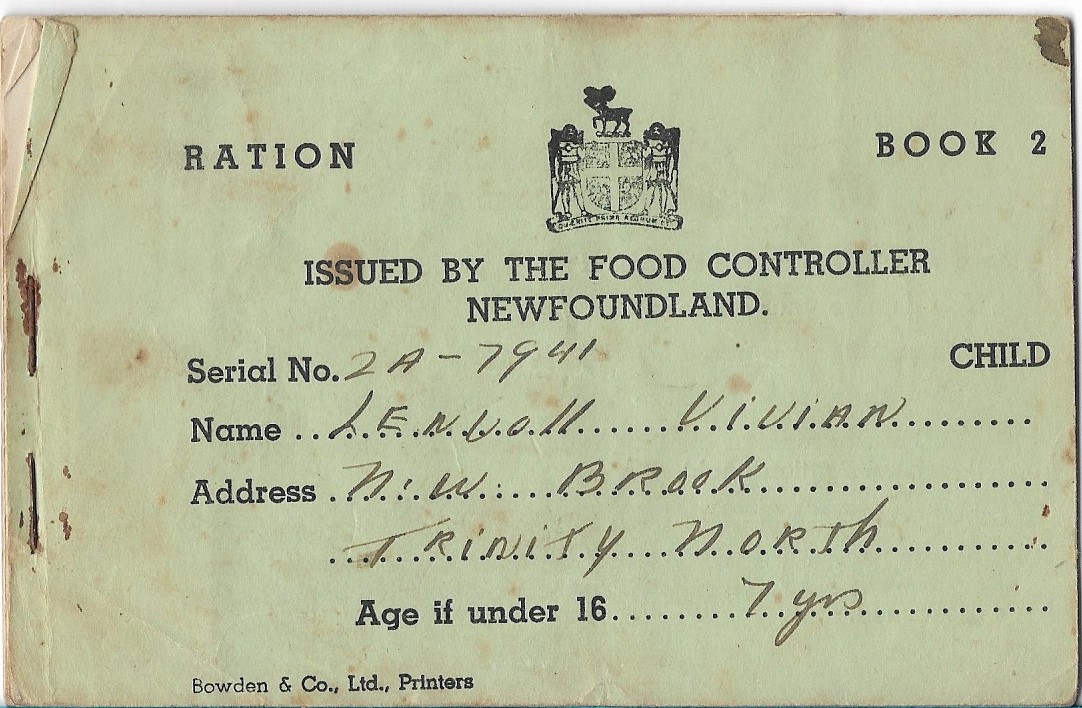 A recent discovery of a kind of family heirloom sparked a discussion about wartime hardships endured by families far from the front lines.
Recollection of the hardships faced by Newfoundlanders during the Second World War is fading as the years stretch farther out between now and then. There are few alive who remember what it was like to live in those times, and the only evidence of it is held in archives and attics. Recently the Vivian family of North West Brook, Trinity Bay, uncovered their family link to a WWII-era government program designed to ensure every Newfoundlander received essential staple foods like tea, coffee and sugar, and to prevent hoarding by individuals.

Lenvoll Vivian
Eighty-six-year-old Lenvoll Vivian gathered with family after his wife, Zelda, was laid to rest in May 2023. While going through the many precious heirlooms, Lenvoll’s daughter, Wanetta, held a booklet labelled “Ration Book 2- Child” with her dad’s name on the cover. She soon uncovered two more just like it. She continued digging until she had six more booklets laid out on the table. Her mind raced with questions for her dad as she closely examined ration books belonging to her father and her grandparents, James and Sarah Vivian.
Three years into WWII, the Newfoundland government accepted that the war raging overseas would last longer than initially predicted by the Allies. Essential stable foods such as tea, coffee, and sugar imported into Newfoundland were becoming more challenging to bring safely across the Atlantic due to the constant dangers of German U-boats targeting merchant ships. To prevent hoarding of staple goods, the government launched a program using the post offices to register and distribute Ration Books to Newfoundlanders.
In May 1943, Deputy Food Controller E.C. Price released a public notice to local newspapers warning Newfoundlanders that if they weren’t registered, they must go at once to the nearest Ranger or Constabulary office to obtain the necessary ration cards. Once the coupon rationing program was initiated, it would not be possible for any individuals to purchase rationed commodities.
Under the Emergency Powers (Defence) Act of 1940, permission was granted to subject tea, coffee and sugar to coupon rationing, effective midnight on the fourth day of July 1943.
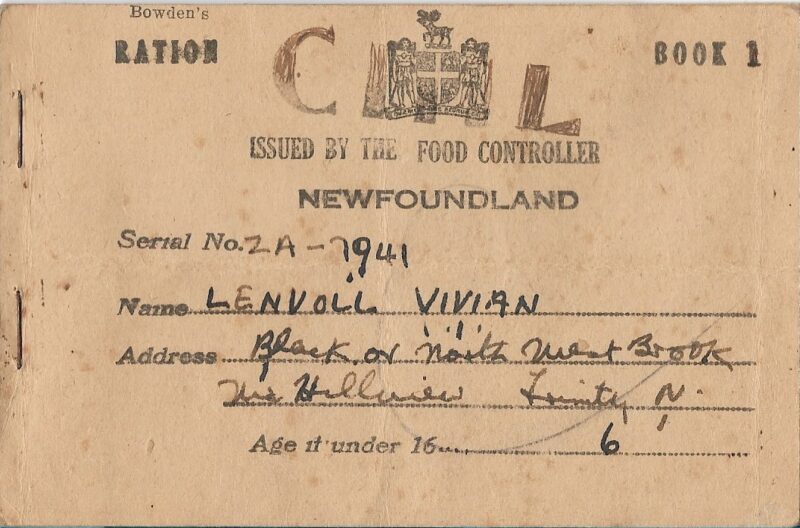
Lenvoll explained to Wanetta that he was six years old when the program started and he got his first ration book. In the following years, two more ration booklets were issued, noting his age on each at seven years and eight years.
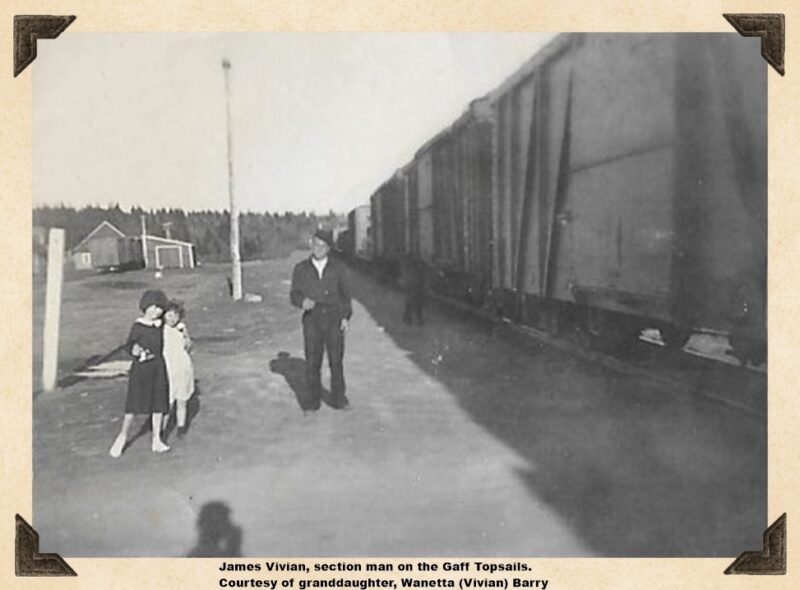
 The registration number GP-2628 was issued to James Vivian and found on all three of his booklets. His address was listed as Gaff Topsail. Lenvoll explained that during the war, his father worked as a section man with the railway, helping repair tracks along the Gaff Topsails. James got the weekends off the first year because it took a day to return home, spend a day with his family, and return to the Gaff Topsails. James then briefly transferred his family to the Gaff Topsails and finally transferred to Northern Bight Station. He was sent to Goobies Station before his retirement.
Sarah Vivian’s booklet number was 2A-7937. The address on Book 1 was recorded as “Black or Northwest Brook Via Hillview, Trinity N.,” indicating that the booklets were sent to the post office at Hillview and picked up by the family. Lenvoll’s booklets recorded the number 2A-7941. He had three older siblings – Jacob, Bram, and Maude – which might explain the missing numbers between her mother’s number and his.
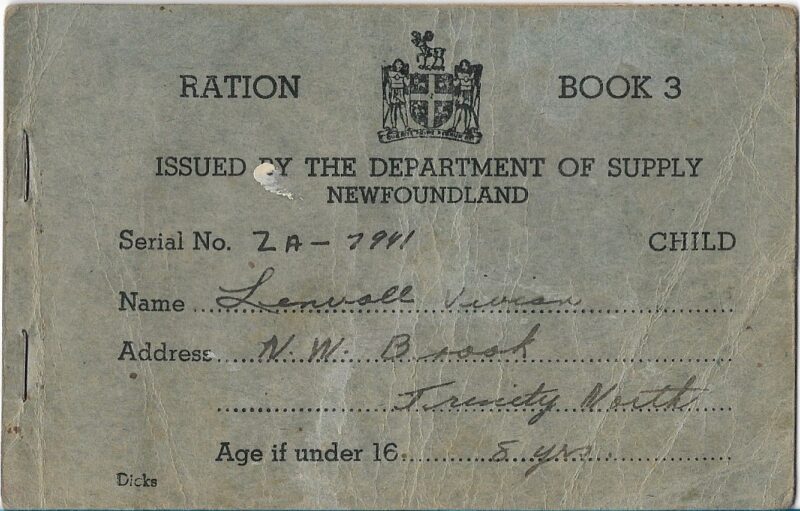 When the Rationing Order was passed in July 1943, the rationed commodities were tea, coffee, and sugar. Later other items were added, including eggs and milk. Initially, the government made an exception for the more isolated area where the registration of individuals proved difficult and delivering food was a challenge, especially during the wintertime.
Florence Curtis exemplifies this difference in the Prince of Wales Memoirs 1950-1962. “…Students coming to the residence during the war years were required to hand over their ration books so they could buy food in bulk. Knowing how difficult it was to obtain food in large quantities, the father of a student from Northern Newfoundland offered to pay part of his student’s fee with a sack of sugar. Apparently, in those parts of the island which were isolated in winter, buying in quantity was permitted….” Elsewhere on the island, each coupon defined a more limited number of rationed items for two weeks, and each booklet was valid for one year.
One memorable moment concerning the Ration Books was recalled by Shirley (Smith) Jennings. She was eight years old, and her mother sent her to the store, operated by Emelina Martin, with the Ration Book. Shirley was to get the rationed amount of two pounds of sugar and return home. After borrowing Bert King’s punt, she rowed across the harbour, walked to the store and got the sugar. She also stopped to visit some friends. Unfortunately, she dropped the brown paper bag on the ground while playing and all of its contents spilled out. She had to return home and explain what had happened to the precious sugar.
 Jim Peddle of Hodge’s Cove told me he remembers the Rations Book. He recalls it contained stamp-like coupons that could be removed. As sugar was limited, his parents sweetened their tea using molasses so the children would have the sugar.
Wanetta noticed as she flipped through her dad’s second book that coupons for evaporated milk and children’s dried eggs remained unused. Her dad explained that his parents did not need to turn in these coupons because the family had hens for eggs and could get fresh milk.
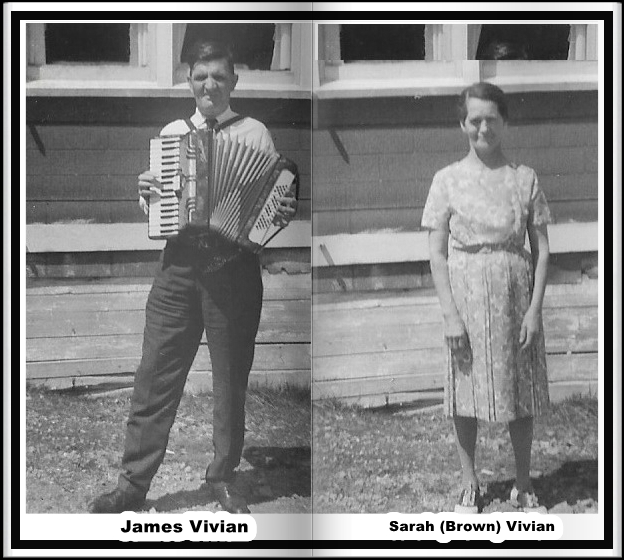 As she held photos of her grandparents, Wanetta reflected on the difficult times her dad’s family must have experienced keeping warm and fed. Her grandfather’s work as a section man caused him to ride the rails to the Gaff Topsails for weeks, taking him away from the family home. Her grandmother and family gathered wood using the dogcat to keep warm. Using the Ration Books for staple foods, and their own garden vegetables and barn animals to put food on the table, they survived a most troublesome time in world history.
Living on Rations – PDF – Downhome article
___________________________________
Transcribed by Wanda Garrett, February 2026.
These transcriptions may contain human errors. As always, confirm these as you would any other source material.