By H. Joseph Seward
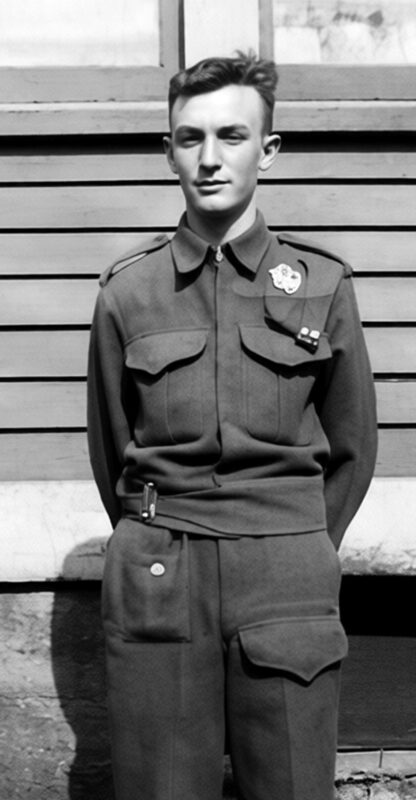
Ernest Smith (Photo courtesy Jeff Spurrell). This photo was AI enhanced.
Ernest Smith was born on 20 June 1924 in Gooseberry Cove, Trinity Bay, Newfoundland, into a long‑established outport family. He was the son of John Richard Smith (1901–1947) and Annie Gladys Spurrell (1908–1946), and the grandson of George Smith (1867–1958) and Elizabeth Bishop (1870–1939)— names that anchor him firmly within the traditional Smith and Bishop lines of the Southwest Arm region.
He grew up in a rural community shaped by fishing, seasonal labour, and strong kinship networks. Like many young men of his generation, Ernest came of age during the Second World War, when enlistment offered both patriotic purpose and economic opportunity. On 27 May 1942, at just 17 years old, he joined the Canadian Army, part of the wave of Newfoundland volunteers who entered military service before Confederation.
Ernest’s military career was brief. Later that same year, while still in training and not yet deployed overseas, he died in the Knights of Columbus Hostel fire in St. John’s in December 1942 — one of the deadliest civilian‑military tragedies in wartime Newfoundland. The fire claimed the lives of soldiers, sailors, airmen, and civilians who had gathered for a social event, and it remains a defining wartime loss in the province’s collective memory.
Ernest Smith’s death at age eighteen placed him among the young Newfoundlanders whose service ended before it truly began. His story reflects the experience of many rural families who saw their sons volunteer with pride, only to lose them far from home and without the recognition that accompanies overseas combat. His short life, rooted in Gooseberry Cove and shaped by wartime duty, stands as part of the broader narrative of Newfoundland’s wartime sacrifice.
____________________________
The following information from taken from Find a Grave website (https://www.findagrave.com/memorial/106290116/ernest-smith)
The most deadly indoor structural fire in what is now Canada [but in 1942 the Dominion of Newfoundland, was not yet a part of Canada] swiftly consumed the Knights of Columbus Leave Centre (Hostel) in St. John’s, Newfoundland on 12 Dec 1942. At about 11 P.M. an arsonist set fire to the wooden building which was covered in imitation shingles, when the building was packed with military personel and their guests. The recreation centre was a firetrap: windows had been boarded over because of the ‘Blackout’ regulations; doors opened inward or were locked or barred from the outside; exits were restricted; there was no emergency lighting system in place; the hall had been decorated with a lot of paper streamers. Within a short 10 minutes after the fire started, 99 people had been killed and 100 more were seriously injured. The main fire station was only 180 metres away, but the building and most of its occupants were doomed before the fire trucks could get there.
The regular weekly Saturday night “Uncle Tim’s Barn Dance” had been going on that night—the event was even being broadcasted on the local radio station. There were about 500 people in the building that; some were at the dance and some were asleep upstairs in the servicemen’s dormitories.
It was the most popular Newfoundland recreation spot for the many Newfoundlander, Canadian, American and British military servicemen, temporarily based in St. John’s-it was their ‘home away from home.’ Three years of work on the part of hospitable Newfoundlanders, interested in giving men of the navy, the army and the air force services a home away from home, was undone in the tragic 10 minutes it took the destructive fire to reduce the two-storey structure to ashes and charred ruins.
Canadian Prime Minister MacKenzie King’s Message:–
Ottawa, Dec. 14. — Prime Minister MACKENZIE KING Sunday night issued a statement expressing sympathy for those whose relatives had lost their lives or had been injured in the St. John’s Nfld. fire Saturday.
The statement said:
“The prime minister is deeply grieved to learn of the loss of life occasioned by the fire at St. John’s, Newfoundland. and wishes to express, through the press, his own sympathy and that of his colleagues for the bereaved families and those who have been injured.”
On the site of this tragic blaze there is a granite memorial commemorating those who died in the fire.
Military Service:-
Rank: Private
Service Number: 583
Age: 18
Force: Army
Unit: Newfoundland Regiment
A labourer by trade, he enlisted in the Newfoundland Regiment on 27 May 1942 in St. John’s, Dominion of Newfoundland; he attested that he had had no previous military force service before enlisting.
Born in Gooseberry Cove in the Dominion of Newfoundland, he was the son of Gladys Smith of Gooseberry Cove, Newfoundland.
Private Ernest Smith is commemorated on Page 197 of the Newfoundland Book of Remembrance. He is also commemorated in perpetuity by the Commonwealth War Graves Commission.
Private Smith is not referred to as a ‘veteran’ by either the Commonwealth War Graves Commission or Veterans Affairs Canada (VAC) for he had had no previous military experience.
______________________
Page created May 2026
Inscription
(Epitaph…)
‘REST IN PEACE.’