Originally published in The Packet, July 2015
by Lester Green
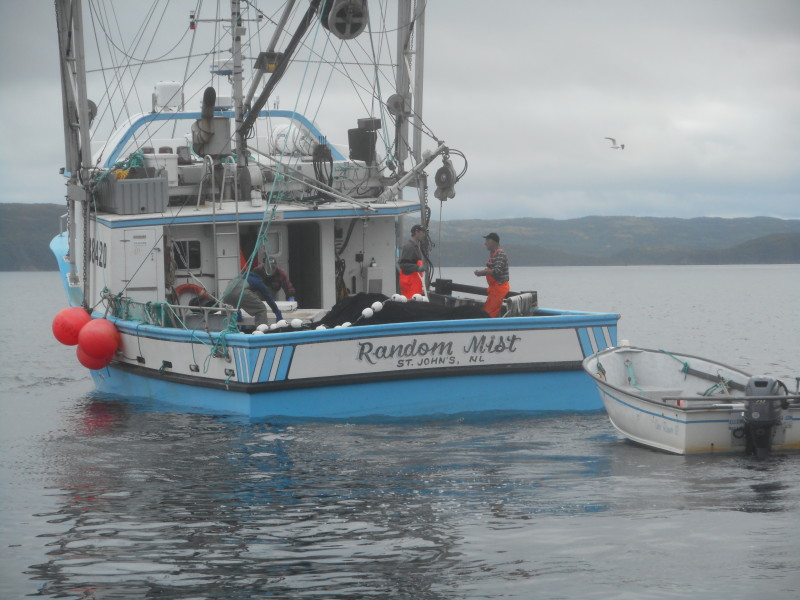
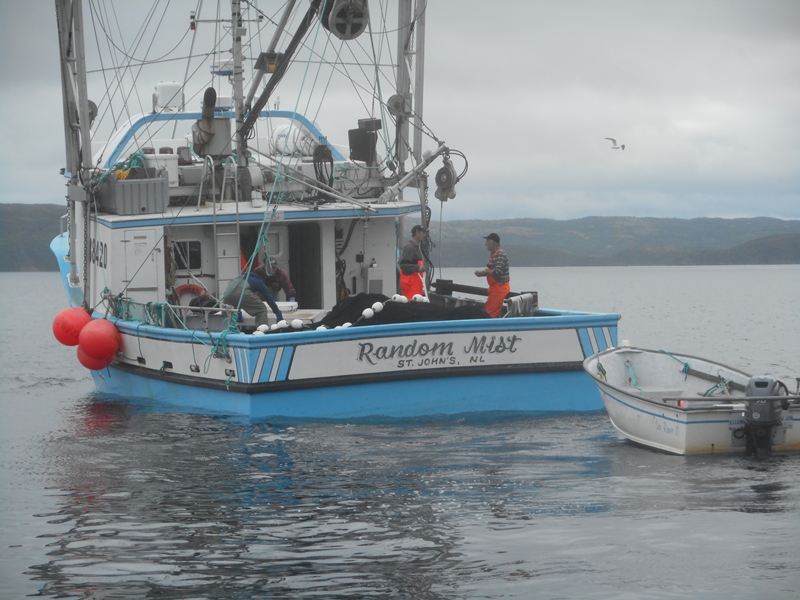
Random Mist heading to Southport to offload caplin at the end of a succesful voyage
It was still dark as fishing folks awoke from their sleep. Daylight would soon break above the horizon. There was time for a quick mug of coffee, along with the taste of jam on two slices of toast. Very little noise was heard from the house as the door was slowly closed, allowing those that were asleep to continue their nightly rest.
But for those who were going fishing, there was the feeling of adventure and anticipation at the thought of what today would bring. For many, it was a yearly routine. Checking the engine oil and conducting a routine inspection of the gear, the skipper prepared his boat for the arrival of the crew. Turning the key resulted in the ringing of the alarm and with the black button pushed, the sound of the diesel engine broke the morning silence in the harbour. This routine could be heard throughout the communities of the Southwest Arm area as the mobile fleet sprang into action for the caplin fishery.
Boats could be seen coming from St. Jones Within, Little Heart’s Ease, Southport, and Gooseberry Cove, heading towards Deer Cove shore. The VHF’s or “the sets” were buzzing with skippers from different boats as they chatted about the direction to steer their enterprises. All the boats had the latest electronic equipment used to find the elusive, newly arriving caplin. The depth sounders were not only used to record the depth of water below the keel but also recorded any school of caplin between the boat and the bottom of the ocean. This occurs because the density of the caplin school causes part of the echo to reflect and return to the receiver, with the remain echo recording the dense bottom. Most of the mobile fleet also have sonar which sends an echo wave to the sides of the vessel to record any caplin that may be within a set range. Armed with these device, the skipper glances intensely at the screens for any sign of caplin. The crew scans the horizon and listens to “the sets” for any sign that other boats may have found caplin. There is chatter among the crew and someone notices that there is a boat with a seine out off Western Head but the skipper also notices that there is a school of caplin on the sonar. The boat’s speed is reduced and the skipper skillfully manoeuvres the vessel over the caplin to show on the depth sounder. The top of caplin is 12 fathoms down, which is to deep for the seine. The skipper pushes the throttle forward and the vessel speeds towards the boats collecting on Deer Cove shore.
When the boat arrives on Deer Cove shore, the fog lifts to reveal a number of boats have arrived during the night from Conception Bay, Bonavista Bay and other regions of Trinity Bay. Deer Cove is dotted with brightly colored red, green, blue and white boats sporting a variety of names and symbols on the sides of the hulls. The boats range in sizes from 35 ft to 65 ft in length with varying carrying capacities of 35,000 lbs to 100,000 lbs. All boats, however, are limited to a daily catch limit of 70,000 lbs. The crew discusses how the Trinity Bay quota will probably only last till the evening but this is no time to spend time talking about the negative, it is time to find, catch and load the boat with caplin.
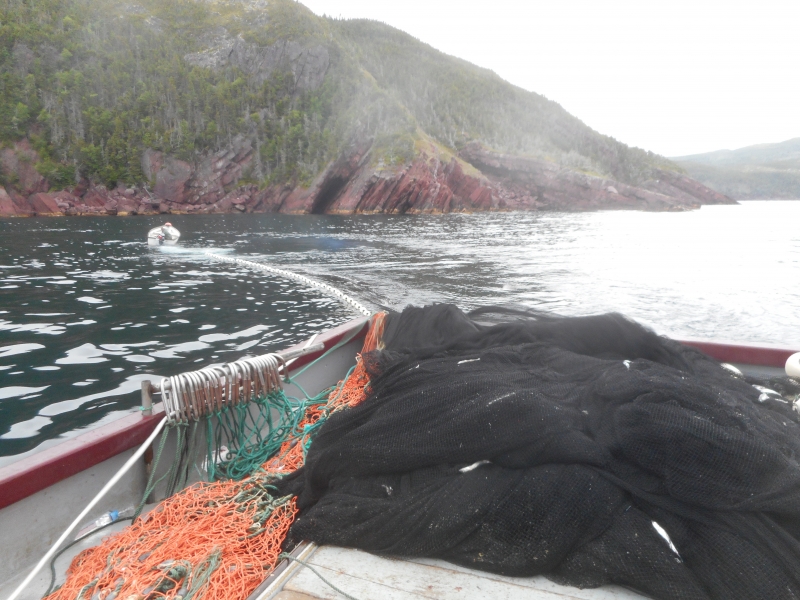
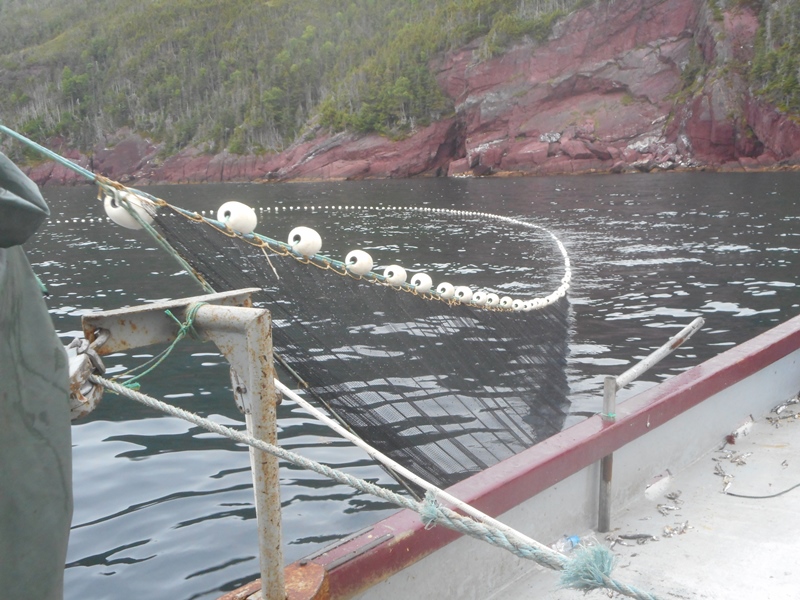
The skipper notices a big marking of caplin on the sonar and runs over the school to see the depth of the caplin and water. Everything looks good and he shouts above the engine, that the person needs to get into the tow-off boat and to start the outboard engine. Now the adrenaline is flowing in the crew members as they set about their individual task like that of a well-oiled machine. Everybody listens intensely for the words from the skipper. Suddenly, the skipper shouts: “Go, go.” ” Head towards Western Head!” The sound of lead weights, rings, tucking rope, twine and floats can be heard ringing continuously of the stern, as the seine leaves the boat and encircles the school of caplin.
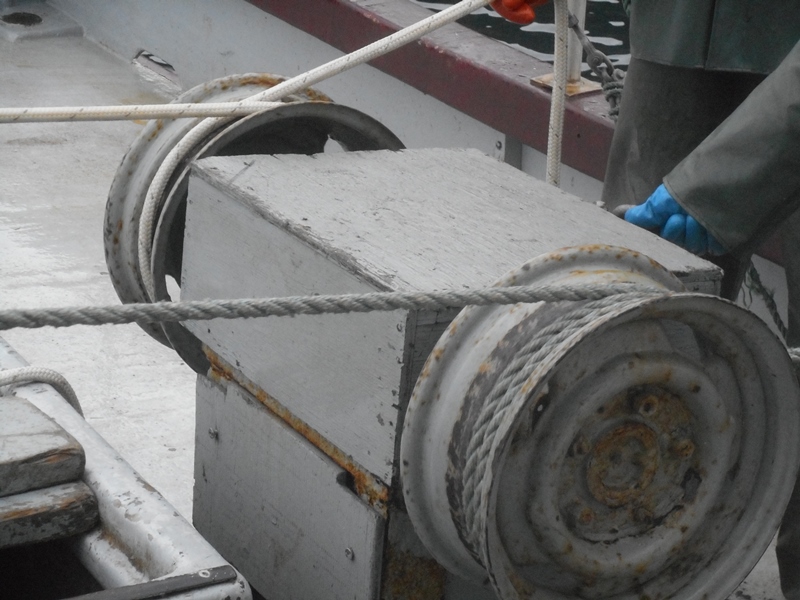
The tow-off boat heads straight back from the boat and the skipper manoeuvres the seiner with skill producing a circle on the surface of water. A crewmember shouts : ” half gone!” A reference to the fact that half the seine rings are now overboard. The skipper now turns the boat towards the tow-off as the crewmember counts downward the number of rings remaining. “6 rings, 5 rings, 4 rings, 3 rings, 2 rings, gone.” With the seine now in the water, the crew springs into action with one member grabbing the boat-hook and retrieving the other end of the seine from the tow-off boat and fasten it to the gunnels of the seiner. The tow-off quickly exits the seine and goes to the opposite side of the seiner. Two other crewmembers place both ends of the tucking rope on the winch and starts to close the seine (tuck) by winching in the rope. With the bottom of the seine closed, the last end of the seine to go overboard is placed in the power block above the deck, and the seine is slowly removed from the water with each crewmember performing different roles. One member operates the controls for the power block, two members places the heads and foots of the seine on the stern of the boat, and others help with the twine. Meanwhile, the tow-off boat operator keeps the seiner from going into the seine.
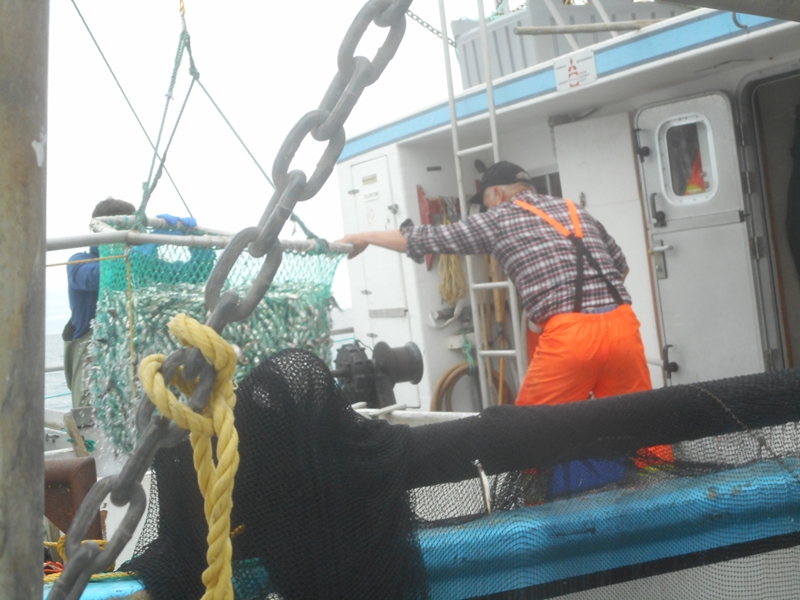
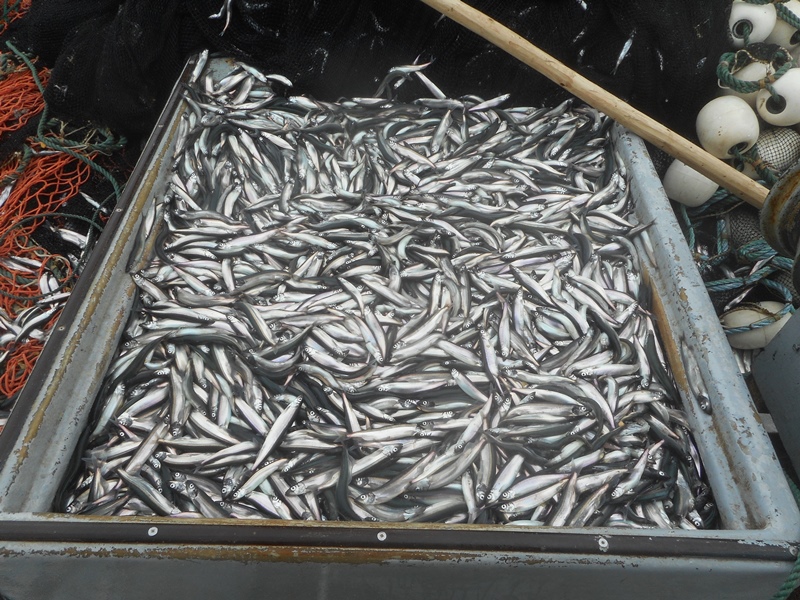
When the seine is almost aboard, the caplin is forced to rise to the surface and a determination is made by the skipper, after checking for red-feed, whether the catch should be dipped aboard. If the caplin is to be taken, the twine is slowly hauled into the seiner until the caplin is on the surface, a process referred to as “drying the caplin”. A large dip net is pushed into the caplin by one crewmember and another hauls it through the caplin lying on the surface of the water. The dip net is hoisted up by the hydraulic boom and pulled towards the hole of the boat where it is released into the hole. This process is repeated until all the caplin is removed from the seine.
Once the caplin have been placed in the boat and the seine is on the deck ready to be placed in the water again, the skipper and crew discuss where they should go next to attempt to finish loading the boat. This process is repeated throughout day until the boat as a successful voyage and heads to port. It is nearly dark when the boat returns to port and ties and waits it turn to unloaded based upon arrival. To get unloaded using the caplin pump may take several hours and most of the crew go below for a snack and a quick snooze. By midnight, the caplin are removed and trucked to the buyer located around the province of Newfoundland.
The crewmembers have one final duty before they can go home for the night. The boat has to be washed and cleaned. Some boats remain at the wharf in Southport, while others continue to their home ports. Some of the boats continue on to the Bonavista Bay where the mobile caplin fishery is opening in the morning.