Reprinted from The Packet, May 26, 2016
by Lester Green
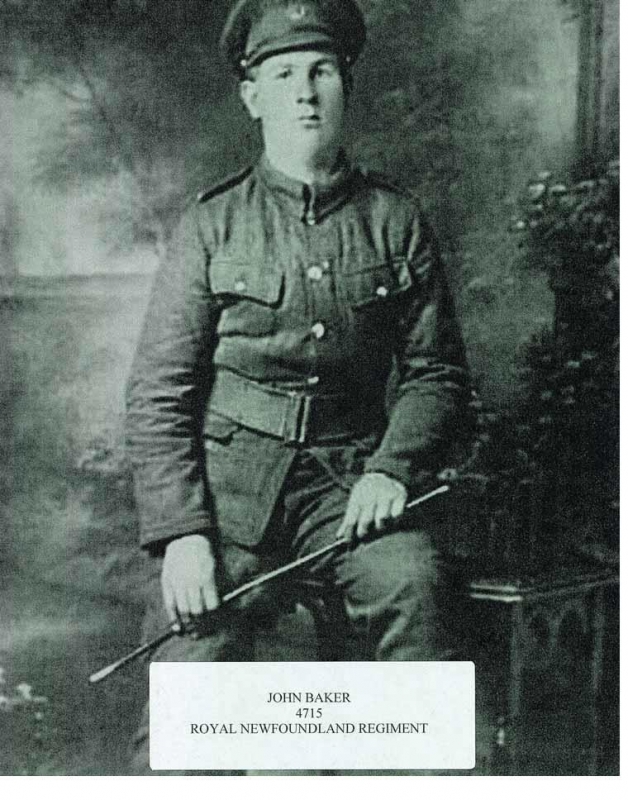
 John Baker was the sole provider for his mother’s family.
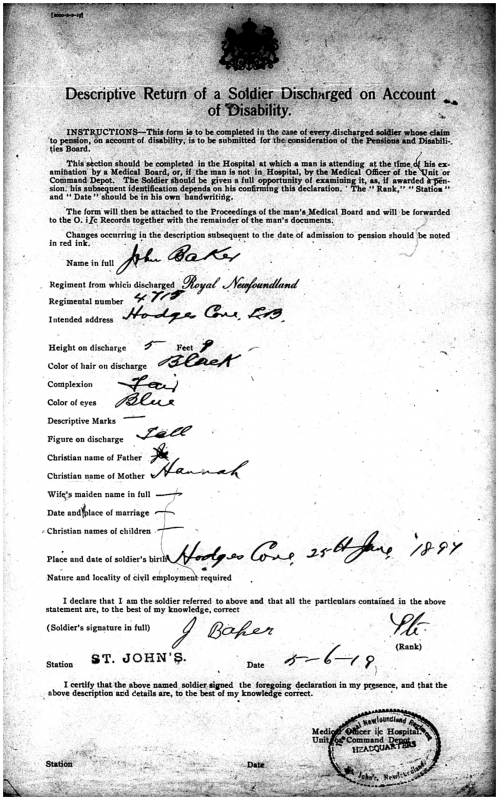
John Baker was born at Hodge’s Cove on June 25, 1896, to Joseph and Hannah (Drodge) Baker. When John enlisted he had two living siblings, Martha and William.
John travelled to St. John’s and completed his enlistment papers on April 26, 1918. He listed his occupation as fishermen. His son, Lloyd, recalls his dad was also involved in the ship building industry in the Random area before going overseas. He began his basic training at Pleasantville.
He was admitted to M.I.D (medical infectious disease) Hospital on May 22, 1918, and treated for measles and discharged on June 17.
Due to his sickness, he missed the opportunity to join his comrades travelling to Halifax on June 11 to Halifax and, from there, overseas. He rejoined the regiment at Pleasantville and continued his training.
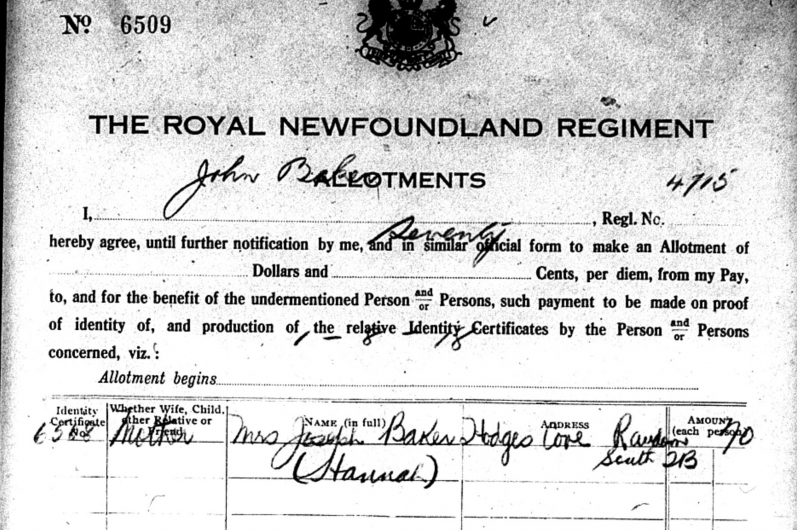
On July 8 he signed allotment papers and listed his mother, Hannah Baker, has beneficiary for 70 cents per diem.
Private Baker received his orders on July 22 that his company was embarking on the H.M.S. Columbella for Halifax. From Halifax, he sailed with a flotilla of ships to the naval port of Liverpool, England.
Also onboard were five other soldiers from the Random area: Arthur Jacobs, William Peddle, Wilson Vey, Bartlett Green and Abel Churchill.
Upon arrival in Folkerstone, England, the company proceeded to Hazeley Down Camps at Winchester. They joined the 2nd Battalion of Royal Newfoundland Regiment.
His company was among the last soldiers from Newfoundland to be sent overseas.
He did not see active duty at the front but continued to receive training in army tactics of proper handling of a rifle, bayonet mounting, hand-to -hand combat and handling of grenades.
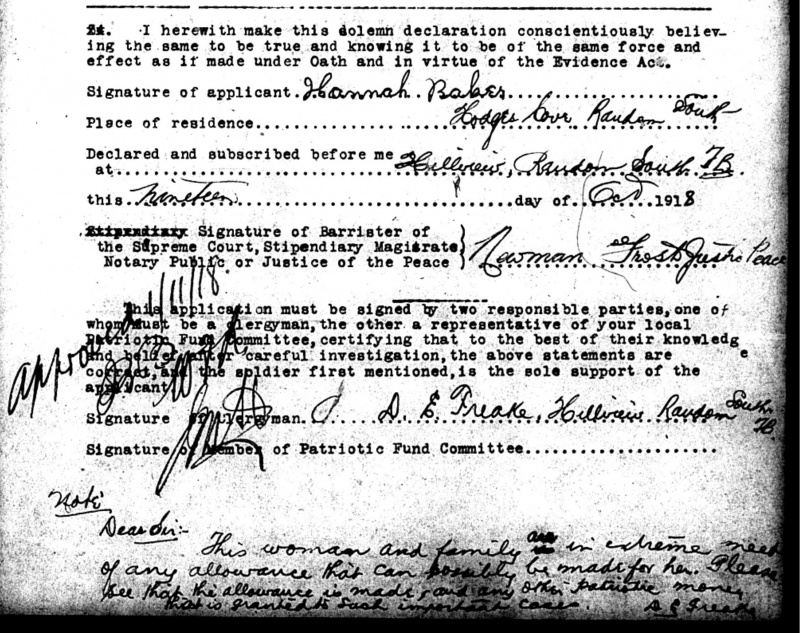
His mother filed for Separation Allowance on Oct. 19, 1918, for financial support. Her son was the family’s only means of support since husband’s death in 1912. She listed two dependents: Martha (19 years) and Thomas (14). A note written at the bottom of the papers by Reverend D.E. Freake shows the desolate need of this family.
“This woman and family are in extreme need of any allowance that can possibly be made for her. Please see that the allowance is made and any other patriotic money that is granted to such important case.”
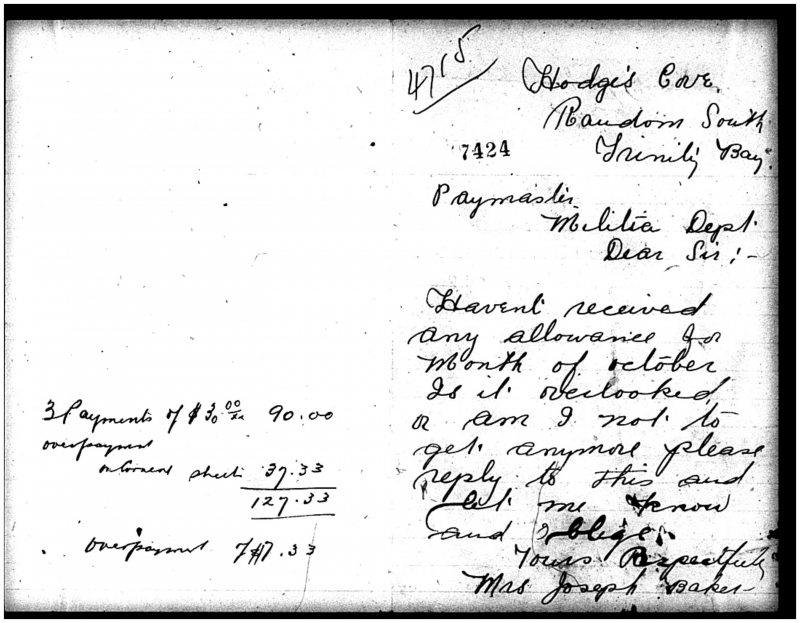
This application was followed by a letter from Mrs. Baker inquiring about her son’s allowance that was not received for October It reads: “Haven’t received any allowance for month of October. Is it overlooked or am I not to get anymore. Please reply to this and let me know….”
Numerical notation on the letter by the Dept. of Militia indicates that she received three payments of $30 for a total of $90, plus another payment for $37.33 for a total of $127.33. It noted an overpayment of $7.33.
In April, she again wrote the Dept. of Militia to inquire about the status of allotment because she received only one payment for March. She was wondering if her son had stopped the allowance.
This type of financial situation was common among families of soldiers that left their family at home with no means of support, other than the allowance that was deducted from their pay. In this case it was noted that she received $21 per month to support her family.
On Apr. 1, 1919, Pte Baker completed his medical report on a Soldier Boarded Prior to Discharge (Army Form B) at Hazeley Down Camps, Winchester. His condition at that time was listed as: “complaining of no disabilities.”
One day prior to sailing for Newfoundland, he received his approval for repatriation. He boarded the SS Corsican, along with several other individuals from the Southwest Arm region, and departed Liverpool for St. John’s on May 22.
Their arrival in St. John’s on June 1 was one of a celebrative nature. Crowds lined the wharves of St. John’s Harbour and boats met them at the entrance.
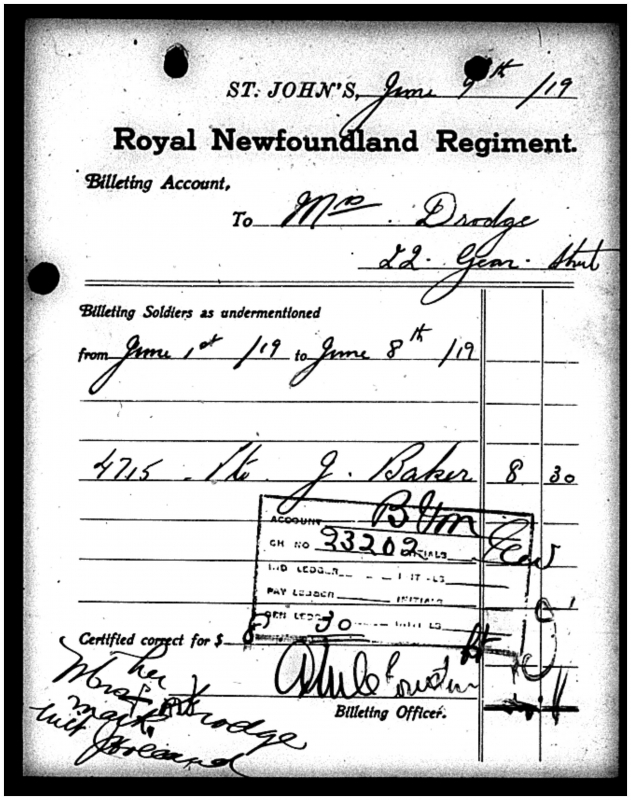
On June 7 his demobilization papers were filed and he was given a $60 clothing allowance, a travel warrant to Hodge’s Cove and was informed that he was eligible for War Gratuity.
In filing his War Gratuity Papers, he listed a service time of 13 months and 26 days, some of which was served overseas at Winchester.
Private Baker received confirmation of discharge along with his Discharge Certificate on July 5, 1919.
He married Ella Grace Hiscock of Winterton on Oct. 10, 1920, at Wesley United Church in St. John’s. They lived and raised their children at Hodge’s Cove.
They moved to St. John’s around 1938, where three more daughters were added to the family.
His family says that before moving to St. John’s, their Dad helped with the construction of the 77 ft schooner Ivy Francis for his first cousin Eli Drodge of Little Heart’s Ease. He worked mostly at carpentry after his arrival in St. John’s, first for Bela Stokes, a friend he met who was also serving with the Regiment overseas, and then for a variety of companies.
He faithfully attended the Wesley United Church in St. John’s until his death on Feb 2, 1963. He was buried in Mount Pleasant cemetery, St. John’s.
Royal Newfoundland Regiment Military Service Record
Private John Baker #4715
April 26, 1918: Enlisted and signed his attestation papers at St. John’s.
May 22, 1918: Admitted to Medical Infectious Disease Hospital, St. John’s with measles.
June 17, 1918: Discharged to duty from hospital.
July 22, 1918: Embarked St. John’s aboard SS Columbella to Halifax.
Oct. 19, 1918: Separation Allowance requested by his mother, Mrs. Hannah Baker.
April 1, 1919: Completed Medical Report at Hazeley Downs, Winchester.
May 1, 1919: Letter from Mrs. James Baker concerning allotment.
May 22, 1919: Embarked Liverpool aboard SS Corsican and arrived St. John’s on June 1.
June 7. 1919: Completed various forms on Proceedings on Discharge.
July 5, 1919: Confirmation of discharge.
July 5, 1919: Discharge Certificate issued
July 16, 1919: First of four payments of $70 for War Gratuity.
Total Service one year, 70 days
There was no record of any medals being awarded to Private Baker but all soldiers who served overseas were awarded the British War medal.