Reprinted from The Packet, June 16, 2016
by Lester Green
Triumphant return on SS Corsican
 Church records indicate that Levi Jacobs was born on Mar. 29, 1897, at Little Heart’s Ease to William James and Hannah (Spurrell) Jacobs. However, he listed March 22, 1897 on military records for his birth date.
Levi, like many others, was aware of the conflict in Europe and understood that Newfoundland, being part of the Dominion of Great Britain, was now at War.
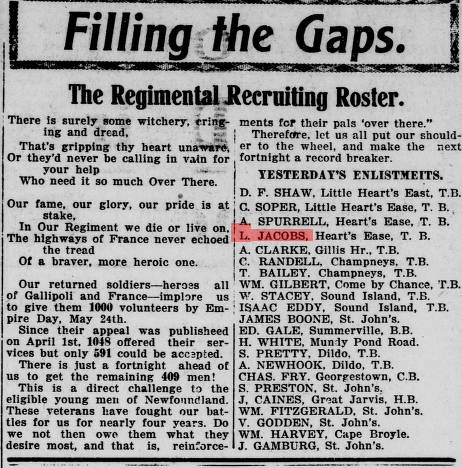
In early May, he left the safety of his hometown, along with Daniel Shaw and Abraham Spurrell, to travel to St. John’s. On May 9, 1918, the Evening Telegram reported the Regimental Recruitment Roster for that day. Among the names were D.F. Shaw, A. Spurrell and L. Jacobs.
On June 11, he boarded a train at St. John’s and travelled across the island to take a ship across the Gulf to Halifax.
His training continued in Halifax while he awaited departure overseas.
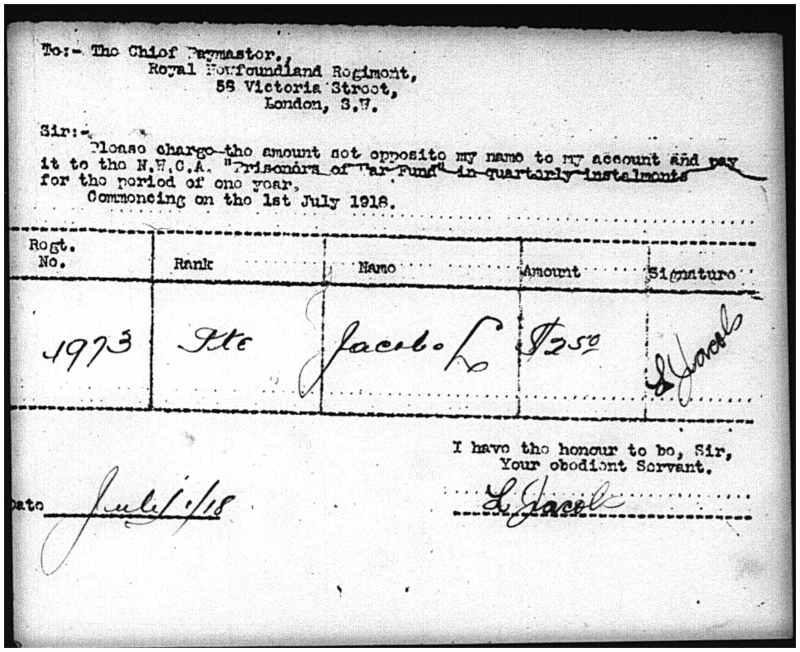
On July 1, 1918, he instructed the Chief Paymaster to deduct the amount of $2.50 quarterly from his account and pay it to Newfoundland War Contingent Association (N.W.C.A) Prisoner of War Fund. This fund was to be used to support prisoners with rations of food and clothing during their time in captivity.
The exact date of his arrival at Hazeley Down Camps in Winchester, England, is not known but it was likely around early September.
A military record indicates he received three pounds from the Paymaster on Sept. 28, 1918. Pte Jacobs is listed as receiving the pay at Winchester. This camp was occupied by the 2nd Battalion of Royal Newfoundland Regiment and used for further training of soldiers from Newfoundland.
In late October, his re-enforcement Draft Number 55, 2nd Battalion was order to join the 1st Battalion, Royal Newfoundland Regiment, which was attached to the British Expeditionary Force.
He was to embark at Folkestone, Southern England on Oct. 26, 1918. He disembarked in Rouen, France and joined the Battalion on Nov. 3, 1918.
For the next several months, Pte Jacobs travelled across France, into Belgium, ending his journey in Germany. During this time the Battalion was ordered to assist in securing Allied positions across Europe as part of the Armistice agreement signed on Nov. 11, 1918 .
Pte Jacobs would have witnessed the atrocities and damage done to parts of France and Belgium during the war. When Pte Jacobs returned to his hometown he seldom, if ever, spoke of this experience.
On April 22, 1919, he was transferred and left the Rouen Camps, France. He embarked at Le Harve, France and arrived in Southampton, England, on morning of April 23.
He joined his fellow soldiers at Hazeley Down Camps, Winchester where his company was assigned guard duty for German Prisoners of War.
On May 22, 1919, he received his demobilization papers and boarded the SS Corsican.
He joined a huge crowd aboard the ship with approximately 1,000 soldiers, consisting of 35 officers and 921 soldiers from the 1st and 2nd Battalions.
Soldiers from the Forestry Corp and war brides had boarded earlier.
The ship pulled out of port to cheering crowds both on the pier at Liverpool and aboard the S.S. Corsican. On board there were several soldiers from Pte Jacobs’ hometown. Among these soldiers were Pte Andrew Shaw, who had spent time as a prisoner of war, and his good buddy, Pte Daniel Shaw.
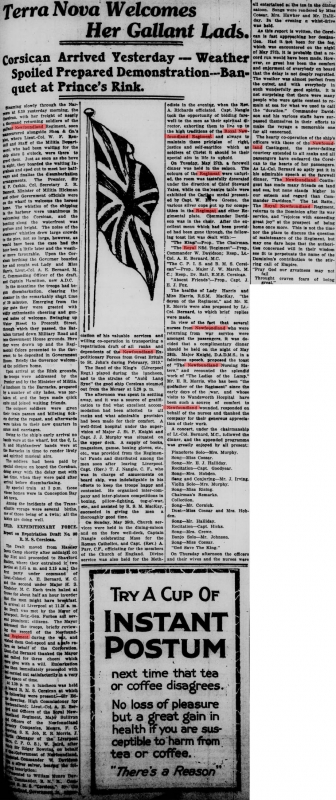
The Evening Telegram carried the headline “Terra Nova Welcomes Her Gallant Lads” on June 2, 1919, and recorded the arrival of SS Corsican with the following words: “…the noise of the shipping whistles was unanimous in welcoming the Corsican…the noise of steamers whistles drew large crowds to the piers, not so large, however, has would have been the case if the arrival was a little later and the weather more favourable…”
Pte Jacobs disembarked and marched with the troops to the Government House grounds, where the Royal Newfoundland Regiment colors were presented to the Governor.
He was discharged from his duties at St. John’s on July 4, 1919. After serving one year and 57 days, he could now return to the peacefulness of his hometown at Little Heart’s Ease to resume his life as a fishermen’s son.
On Sept. 9, 1921, Pte Jacobs received two medals for his service in the Royal Newfoundland Regiment . On Sept 13, he acknowledge receiving both Victory Medal and British War Medal.
On Feb. 22, 1920, Pte Jacobs married Susie Lacey from Wesleyville. She was teaching at the Methodist Church in his community at the time of his return.
They had two children, one of whom died at an early age. Later Levi and Susie would leave Little Heart’s Ease and move to Baie Verte where he found work as a lumberman. Levi passed away in August of 1980, aged 83.


Private Levi Jacobs, Regiment #4973
Royal Newfoundland Regiment Military Service Record
May 9, 1918: Enlisted and signed attestation papers at St. John’s.June 1, 1918: Allotment for his mother, Mrs. William (Hannah) Jacobs for 55 cents per diem.June 11, 1918: Embarked St. John’s by train to Halifax, NS with draft 55.
July 1, 1918: N.W.C.A. “Prisoner of War Fund” deduction of $2.50 quarterly installments.
Sept. 28, 1918: Pay 3.00 pounds from the Chief Paymaster to Levi Jacobs, Winchester, England.
Oct. 26, 1918: Embarked from Folkestone, England for British Expeditionary Forces at Rouen, France.
Nov. 3, 1918: Joined 1st Battalion of Royal Newfoundland Regiment and spent next 6 months crossing France, Belgium and into Germany.
April 22, 1919: Transferred from Rouen Camps and embarked at Le Harve, France for Southampton.
April 23, 1919: Arrived at Hazeley Down Camps at Winchester, United Kingdom.
April 29, 1919: Medical report competed at Hazeley Down Camp for repatriation.
May 22, 1919: Boarded SS Corsican at Liverpool bound for St. John’s, Newfoundland for demobilization
June 1, 1919: Arrived Newfoundland and reported to headquarters.
June 4, 1919: Proceeding for demobilization started at St. John’s.
June 20, 1919: Demobilization approved by O.C. Discharge depot and discharged.
July 4, 1919: Received Discharge Certificate.
July 5, 1919: Letter concerning payment of $70 War Gratuity.
Sept. 25, 1920: Received Army Book 64.
Sept. 13, 1921 Received Victory Medal and the British War Medal.
Total Service: Private Jacobs served his King and Country for 1 year and 57 days.