By Josh Goobie
Reprinted from The Packet, August 31, 1993
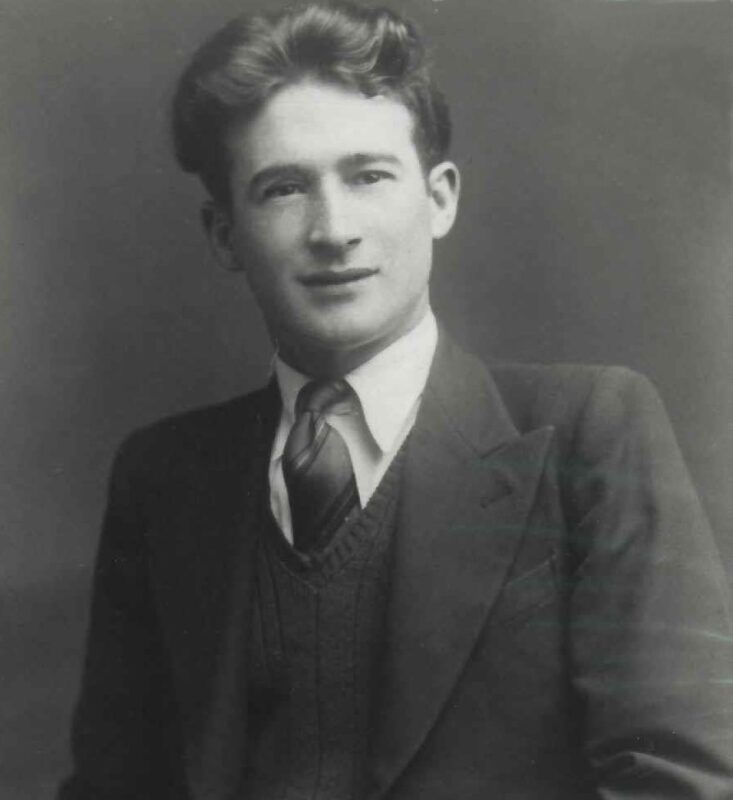
Josh Goobie
A reunion of the N.O.F.U. was held Aug. 20-22 in Botwood. Today it brings fresh to my memory of my young days and of enlisting for the forestry unit. It was from this part of Botwood that we sailed from, on Jun 25, 1940.
When the King made a call for men to come to the defense of Britain, I felt the desire to answer the call. But I would not be 17 years old until Nov. 24 of that year. But in June of 1940, despite stiff opposition from my family, I was on my way. I celebrated my 18th birthday in Dingwall, Scotland.
Leaving Clarenville for Bishop’s Falls, we spent three days and nights sleeping across board seats in passenger rail cars (a rough start). It was bad timing on someone’s part. We waited there until a contingent of 1,000 soldiers of the Black Watch were disembarked, the first soldiers to arrive from Canada. On Sunday evening we were ferried on board of the troop ship Anthonia by the old M.V. Glenco. On the following Sunday, about two o’clock, we docked in Liverpool, England, just a few days after the fall of Dunkirk.
There were soldiers going to and fro, prisoners being marched to the train for prison camps, German planes sweeping overhead, sirens sounding. It was not so peaceful as it was back in Queen’s Cove, Newfoundland, the home I had left just a week ago.
Finally we received orders to go onboard the train for Carbridge in Scotland. We arrived at eight o’clock the next morning. Travelling through the wonderful countryside of the British Isles, it was something to behold. Things such as that I love to remember, not the bombed out cities, which the British suffered more than their share.
A hard days work was spent cutting and shipping wood to the mines, for the purpose of mining coal, to supply the factory with the energy for making ammunition and many other things. Poles were erected on beaches, and sand bars, and in low-lying areas to stop the enemy from coming ashore.
 At night we would be out on drill and we also had to learn to use the weapons of war such as rifles, machine guns and grenades.
We also did guard duty on the hills and on the beaches of the British Isles, watching and listening to in the event of an invasion. The N.O.F.U. played a vital part in bringing the war to an end.
Newfoundlanders were a different breed of people, because in those days when I was young you were brought up with an axe in your hand. It was either a fishing boat or a sawmill. There was vey little to do. So you were a trained logger when you were 12 or 14 years old. You were in the woods with your father.
I guess that’s why they called the Newfoundlanders. They tried to train the Scotsmen, but they were nothing compared to us.
First when we went over there the living quarters were bad. They used to give us what they called a mattress, in three pieces. That was as hard as the devil’s head. And you made your bunk with it. You laid it out and spread your blanket over it. This first camps were made out of wood, something like Indian style. So many of the men were detailed off to build the sleeping quarters. Later we got other camps that even had showers.
I was never involved in any actual fighting but we were well trained for it.
Our pay was $2 a day, $52 a month ad half that had to be sent home.
I have been over once since then, visiting France, the north of Scotland, England, Inverness. I’m thinking of going over again this year for a visit.
Others who sailed from Botwood in June 1940, who were from Queen’s Cove were Max Pinsent, Jonathan Gregory, George Butt, Robert Cooper and Douglas Cooper. Two others Kenneth Churchill and Lester Stoyles were from Hillview.
_______________________
Transcribed by Wanda Garrett, May 2026
These transcriptions may contain human errors. As always, confirm these as you would any other source material