Reprinted from The Packet, June 9, 2016
by Lester Green
Answers call for “Rescue Bunch”
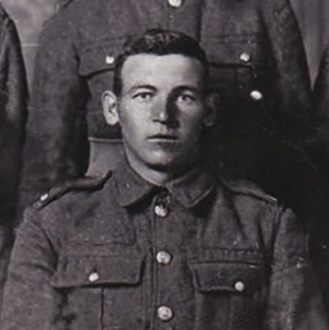 Eldred birthplace appears to be a mystery. Some believe it was Hodge’s Cove while others, Queen’s Cove, where his father, Ambrose, worked at a sawmill called Seward’s Mill near Goobies. When asked to list place of birth and date on enlistment papers, he listed Trinity Bay, Oct. 22, 1898. His parent’s, Ambrose and Margaret Ann (Pinhorne), had children born at Hodge’s Cove but most were born at Queen’s Cove. The family moved to St. John’s and lived at 53 Duckworth St. prior to the start of the Great War in 1914.
Nathan, Eldred older brother, attempted to join the Regiment two years earlier but failed to pass the medical exam. Pte Churchill responded to an ad for more volunteers for the Royal Newfoundland Regiment. The ad stated:”The Rescue Bunch of the glorious Newfoundland Regiment is looking for you….” Eldred, successfully passed the exam and enlisted on May 1, 1918. His address was listed as 53 Duckworth Street, St. John’s.
During the next two weeks, Pte Churchill, would be re-united with several of his buddies from the Southwest Arm region who had come into the city to join the Regiment. Before they were assigned overseas, a group photo was taken at Holloway’s Studio in their military uniform, possible for posterity.
An allotment of 60 cents was removed from his wages and made payable to his mother, Mrs. Ambrose Churchill on May 16, 1918.
Pte Churchill, along with Pte Levi Jacobs and Pte Daniel Shaw received orders to board a train and departed St. John’s on June 11 for Halifax. During his stay at Halifax, he would give permission to have quarterly payments of $2.50 cents removed from his pay and placed into N.W.C.A. (Newfoundland War Contingency Association) Prisoner of War Fund. The exact date of departure from Halifax to go overseas is not known.
It is believed that he arrived at Hazeley Down Camp, Winchester, England sometime in early September. He continued his training with 2nd Battalion and awaited his orders to the front line.
His orders on Oct. 26 stated that his troop was to proceed to Folkestone where they were to embark for Rouen, France and join the British Expeditionary Forces. On Nov. 23, he joined the 1st Battalion commanded by Lt. T.G. Mathias, D.S.O Commanding 1st Battalion, A Coy.
He spent the next 5 months in France securing weapons and prisoners as part of the Armistice Day agreement reached between the Allies and Germany. On April 22, he was transferred from Rouen Camps and embarked at Le Harve for Southampton, England. He reached the Hazeley Down Camps at Winchester on April 23.
Proceedings began on April 29 for his eventual repatriation from the army when he was asked to complete a medical report at Hazeley Down Camps.
He would have participated in the festive celebration during May 3 victory parade through the streets of London. This celebration was known as Triumphal Victory March of Dominion Troops. Soldiers representing Canada, Australia, New Zealand, South Africa and Newfoundland would have proudly marched alongside their British counterparts celebrating the end of the Great War.
Pte Churchill boarded the SS Corsican on May 22 with his comrades and arrived in Newfoundland to a festive crowd on June 1, 1919.
Proceedings for his demobilization began on June 14 and confirmation of his repatriation was received on June 29. Between June 1 to 14, he was billeted at 34 Bond Street, St. John’s. Pte Churchill had served his country for 1 year and 60 days.
On Sept 16, 1921, he received the Victory Medal and the British War Medal for his dedicated service to King and Country.
The Evening Telegram recorded his marriage on Sept 15, 1921. It read: “A quiet but pretty wedding took place Wednesday, Sept 7, at Cochrane Street Methodist Church, when Miss Clara Belle Barnes, daughter of Mr. and Mrs. Frank Barnes of Champney’s, Trinity, by Rev. Mr. Johnson to Eldred Churchill, son of Mr. and Mrs. Ambrose Churchill of this city…”
They lived at St. John’s for a short period time and moved to the United States in 1923 and lived at Ford City, Pennsylvania. He worked as a carpenter most of his in the Ford City area. After the death of his first wife, he re-married Allison Laite of Petley. He passed away in 1987 and is buried at Ford City Cemetery, Armstrong County, Pennsylvania, USA.


Royal Newfoundland Regiment Military Service Record
Private Eldred Churchill #4857
May 1, 1918: Attested for General service with Royal Newfoundland Regiment.
May 16, 1918: Allotment of 60 cents payable to his mother, Mrs. Ambrose Churchill.
June 11, 1918: Embarked St. John’s by train to Halifax for overseas.
July 1, 1918: $2.50 deducted from Pay for NWCA “Prisoner of War Fund”.
Oct. 26, 1918 Embarked from Folkestone, England for British Expeditionary Forces at Rouen, France.
Nov. 3, 1918: Joined the 1st Battalion commanded by Lt. T.G. Mathias, D.S.O Commanding 1st Battalion. A Coy.
April 22, 1919: Transferred from Rouen Camps and embarked at Le Harve, France for Southampton.
April 23, 1919: Arrived at Hazeley Down Camps at Winchester, United Kingdom.
April 29, 1919: Medical report completed at Hazeley Down Camps for repatriation.
May 22, 1919: Boarded SS Corsican at Liverpool bound for St. John’s, Newfoundland for repatriation.
June 1, 1919: Arrived Newfoundland and reported to headquarters.
June 13, 1919: Descriptive return of a soldier on account of disability completed.
June 14 to 16, 1919: Demobilization of Pte E. Churchill.
June 16, 1919: Billeting receipt for stay at 34 Bond Street between June 1 to 14.
June 16, 1919: Demobilization approved by O.C. Discharge Depot.
June 16, 1919: Civil Re-establishment Committee form signed and agreed to resume former occupation.
June 16, 1919: War Service Gratuity form completed.
June 29, 1919: The discharge of the undernoted on demobilization confirmed by Officer i/c records.
June 29, 1919: Discharge certificate #2538 received in a letter.
Sept 16, 1921: Received Victory Medal and British War Medal.
Total Service… 1 year and 60 days